
Benefits of Providing High-Quality Coffee in the Workplace
In a modern business office, coffee is more than just a beverage – it’s a daily ritual that can influence employee performance and shape client perceptions. Investing in high-quality coffee for the office can yield numerous benefits. This report examines the advantages for two key groups: (a) employees and (b) clients, and considers the cost implications and return on investment (ROI) for businesses. Short, engaging coffee breaks and a great cup of coffee can have outsized positive effects on morale, productivity, and professional image. The insights below are organized by audience (employees vs. clients) and backed by research, surveys, and expert observations.
Benefits for Employees
Providing quality coffee for employees isn’t just a perk – it can directly impact how people work and feel at the office. Below we explore how good coffee influences employee productivity, morale & job satisfaction, and retention.
Improved Productivity and Focus
A strong cup of coffee can kick-start the workday and keep employees operating at peak performance. High-quality coffee positively affects mental alertness and work output in several ways:
Boosts Alertness and Cognitive Function: Caffeine is a natural stimulant that enhances brain activity. Studies show that coffee can improve focus, memory, attention, and reaction time, helping employees stay sharp on tasks (The Impact of Coffee on Employee Productivity and Engagement | Pot O’ Gold Coffee Service). For example, consuming 1–2 cups (100–250 mg of caffeine) has been scientifically proven to improve alertness and mental performance (The Top 6 Reasons to Provide Coffee in your Workplace | 360Connect). In essence, a well-caffeinated team is often a more productive team.
Reduces Fatigue and Slumps: Coffee helps combat the post-lunch or mid-afternoon energy slump. By reducing feelings of fatigue, employees can work for longer periods without a drop in efficiency (The Impact of Coffee on Employee Productivity and Engagement | Pot O’ Gold Coffee Service). This means fewer slow afternoons and more consistent productivity throughout the day.
Keeps Employees On-Site (Less Lost Time): Offering good coffee in-office means staff are less likely to leave the workplace for a caffeine fix. Research indicates that when employees don’t need to venture out to a café for their favorite drink, it often saves about 30 minutes or more of otherwise lost work time (Great Coffee in the Workplace Boosts Employee Productivity). In fact, one report found that a daily off-site coffee run can translate to 60+ hours of lost work time per employee per year, costing over $1,100 in productivity per employee annually (US Office Coffee Services Market Trends & Opportunity). By having quality coffee readily available, businesses reclaim this time – employees can grab a cup and get back to work quickly, keeping momentum and focus. (See Cost & ROI section for more on productivity losses due to coffee runs.)
Enhances Worktime Efficiency: A well-stocked coffee station can even improve workflow efficiency. Employees can schedule quick “coffee breaks” between tasks or meetings to recharge without leaving the building. These micro-breaks, when spent in the office, can actually increase overall productivity – short pauses help the brain reset, leading to more effective work when employees return to their desks (The Top 6 Reasons to Provide Coffee in your Workplace | 360Connect) (The Top 6 Reasons to Provide Coffee in your Workplace | 360Connect). Essentially, convenient access to coffee keeps the workday running smoothly with minimal downtime.
Higher Morale and Job Satisfaction
Beyond the physical boost, good coffee serves up a psychological lift. The availability of high-quality coffee in the workplace can significantly improve employee morale, mood, and job satisfaction:
Employees Feel Valued and Cared For: Providing premium coffee signals that the company cares about employee comfort and well-being. Surveys back this up – eight in ten office workers say they would feel more valued if their employer offered high-quality beverages like good coffee (). In a McKinsey & Co. study, 61% of employees said that having employer-provided hot beverages shows them that their company cares about their well-being (The Top 6 Reasons to Provide Coffee in your Workplace | 360Connect). This sense of being valued translates into happier, more motivated staff.
Improved Mood and Enjoyment at Work: A flavorful cup of coffee can simply put employees in a better mood. According to a Staples workplace survey, 82% of employees reported that coffee at work improves their mood (The Top 6 Reasons to Provide Coffee in your Workplace | 360Connect). It’s a small daily pleasure that can make the office feel more hospitable. When people can look forward to a “good cup of joe” at the office, they tend to be more excited about coming in to work and feel more comfortable throughout the day (The Top 6 Reasons to Provide Coffee in your Workplace | 360Connect). This positive mindset can reduce stress and create a more upbeat office atmosphere.
Boost to Morale and Energy: Coffee breaks often serve as mini morale boosters. 85% of employees in the same study agreed that quality coffee increases both productivity and morale (The Top 6 Reasons to Provide Coffee in your Workplace | 360Connect). The routine of grabbing coffee can add structure and a small reward in the workday, keeping employees energized and mentally refreshed. It’s no coincidence that many workplaces see higher engagement after upgrading their coffee machines or beans – it’s a beloved perk that resonates with staff.
Social Interaction and Team Bonding: The coffee station or breakroom coffee pot often becomes a social hub. Colleagues chatting over lattes or discussing projects during a refill can foster camaraderie and teamwork. Informal interactions at the coffee machine encourage casual conversations that can spark new ideas and collaboration (The New Role of Office Coffee in Today’s Workplace.). In fact, the MIT Sloan School of Management found that coffee breaks encourage the kind of spontaneous conversations that strengthen team relationships and knowledge-sharing (The New Role of Office Coffee in Today’s Workplace.) (The New Role of Office Coffee in Today’s Workplace.). This social aspect of coffee breaks helps build a sense of community at work, contributing to a positive culture and higher job satisfaction.
Enhanced Employee Retention
When employees are more productive, happy, and feel appreciated, they are far more likely to stay with the company. Offering great coffee can thus support employee retention in several ways:
Higher Job Satisfaction = Lower Turnover: There is a well-documented link between job satisfaction and retention. By improving daily satisfaction (through perks like good coffee), companies can reduce the likelihood of employees looking elsewhere. “All in all, people feel appreciated and have higher job satisfaction when their office provides good-tasting coffee… This leads to less employee turnover” according to workplace surveys (The Top 6 Reasons to Provide Coffee in your Workplace | 360Connect). In other words, a coffee machine might help save on recruiting costs by keeping your talent happy. Employees who view the coffee station as a sign of the company’s appreciation will remember that when considering other offers.
Building Cohesion and Loyalty: Coffee breaks contribute to employee cohesion, which is a key factor in retention. When coworkers bond and develop friendships during coffee chats, it creates a supportive work environment that people don’t want to leave. Sharing a cup of coffee can be “the glue” for team cohesion – and strong cohesion has been linked to both better productivity and higher worker retention (). People are naturally more loyal to workplaces where they feel connected to colleagues. By facilitating those connections, an office coffee program indirectly boosts loyalty.
Return-to-Office Incentive: In the era of hybrid work, quality coffee has even been used as an incentive to bring people back to the office. A 2024 survey of corporate real estate professionals (CoreNet Global) found that over 50% of employers are offering “good coffee” as a top amenity to encourage on-site attendance (50% of Companies Offering “Good Coffee” to Encourage Return To Office | Comp News) (50% of Companies Offering “Good Coffee” to Encourage Return To Office | Comp News). This underscores how valuable coffee is perceived in engaging employees. While flexible work arrangements matter, many companies discovered that free barista-quality coffee can sweeten the deal to have employees happily come in regularly. Getting staff back in-office, even part-time, can strengthen their connection to the company and reduce attrition in the long run.
Comparative Advantage in Talent Retention: High-quality coffee can even be a differentiator when employees weigh job options. It sounds trivial, but consider that if two companies offer similar pay and benefits, the daily work environment perks can tip the scales. A robust coffee program is a sign of an employee-centric culture. As one analysis noted, if your office coffee is delicious and “the competitor’s tastes like dirty water, it could cause a prospect to choose your company” (How Much Does Office Coffee Service Cost?). Once hired, employees are more likely to stay where they feel their daily needs (like good coffee) are met. It’s part of creating a workplace where people want to stay long-term.
In summary, investing in quality coffee for employees yields a more alert, motivated workforce and cultivates a positive workplace culture. These factors feed directly into higher productivity and lower turnover – all beneficial to the company’s bottom line.
Benefits for Clients (Visitors and Customers)
Offering high-quality coffee doesn’t only influence your employees; it also leaves a strong impression on clients, customers, and other office visitors. Whether it’s a prospective client in the conference room or a customer in the lobby, a good cup of coffee can enhance their experience and perception of your business. Below, we outline how quality coffee contributes to client-side benefits in terms of professionalism & hospitality, client satisfaction & experience, and relationship building & loyalty.
Enhanced Professionalism and Hospitality
The moment a client walks into your office, the details of their welcome experience set the tone. Providing great coffee (or tea) as part of that welcome can signal warmth, professionalism, and attention to detail:
Positive First Impressions: First impressions are crucial in business, and something as simple as offering a client a cup of quality coffee can make that first encounter memorable. A well-appointed reception area with a nice coffee machine immediately shows hospitality. It demonstrates that your company values the client’s comfort and has prepared to receive them. As one industry expert notes, when you offer coffee to visitors, you instantly give the feeling that you value your customers and care about their needs (How Coffee Plays A Part In Welcoming Visitors To Your Offices) (How Coffee Plays A Part In Welcoming Visitors To Your Offices). This thoughtfulness in the reception area contributes to an overall image of professionalism and courtesy.
Attention to Detail – A Reflection of Your Brand: Serving high-quality coffee (especially a known premium brand) in client meetings or the lobby can reinforce your company’s image of quality. It appeals to the senses – aroma and taste – showing that you’ve gone the extra mile beyond just the “business basics”. “Offering coffee…appeals to an extra sense. An established [coffee] brand adds further reassurance of quality”, building a stronger impression of your business’s excellence (How Coffee Plays A Part In Welcoming Visitors To Your Offices). In competitive industries, these small details set you apart. Clients may subconsciously equate the care you put into small things (like coffee) with the care you put into your core services.
Displays Professional Hospitality: Many companies pride themselves on treating clients as guests. Providing a beverage is a standard of etiquette in hospitality, and in the office context it conveys respect. For example, law firms and consulting businesses often offer a cup of coffee or espresso to clients waiting for a meeting as a sign of professional courtesy. It sends a message: “We’re prepared for you, we welcome you.” This can be especially important if a client has traveled or had a long day – a refreshment makes them feel taken care of. Such gestures can improve how professional and client-focused your organization appears. As a result, clients may be more at ease and open in discussions, setting the stage for a productive meeting.
Mitigating Waiting Discomfort: In situations where clients or visitors must wait (e.g. in a lobby or before a meeting), offering coffee can significantly improve their comfort. A waiting room with available coffee and tea feels inviting rather than tedious. Studies in customer experience note that when people are occupied with a pleasant activity (like sipping a drink), wait times feel shorter than they actually are (How Offering Coffee Can Elevate Customer Experience in Waiting Rooms). Instead of watching the clock, clients can relax with a cappuccino, which eases any impatience. This level of hospitality – comparable to what top hotels or car dealerships provide – reflects well on your company’s image. It subtly communicates “we care about your experience at every step.”
Improved Client Satisfaction and Experience
Just as employees appreciate good coffee, clients notice it too. Providing a quality coffee experience can enhance overall client satisfaction with their visit and create a more favorable environment for doing business:
Clients Feel Valued and Comfortable: A hot drink can physically and emotionally comfort a person. When you hand a client a nicely brewed cup, they often feel acknowledged and valued. It’s a thoughtful gesture that can set clients at ease, especially if they are about to engage in serious discussions. “Providing complimentary coffee can have a significant impact on how customers feel about your service. It’s a small but thoughtful gesture that shows you care about their well-being” (How Offering Coffee Can Elevate Customer Experience in Waiting Rooms). This kind of care can make clients more relaxed and positive during meetings, improving the tone of interactions.
Reduced Tension in High-Stress Situations: In industries like finance, legal, or medical services, clients may arrive feeling anxious or stressed about the proceedings. Offering coffee (or even a selection of drinks) can help soften the formality and tension. Coffee has a calming ritualistic effect for many people – the act of holding a warm cup and sipping can alleviate stress. As noted in one analysis, “a simple addition such as a coffee machine can dramatically improve the waiting experience… it allows clients to focus on something familiar rather than any anxiety” (How Offering Coffee Can Elevate Customer Experience in Waiting Rooms) (How Offering Coffee Can Elevate Customer Experience in Waiting Rooms). By easing nerves, you enable a more productive and open conversation once the meeting begins. The client’s satisfaction with the interaction will naturally be higher if their emotional state is comfortable.
Enhanced Perception of Service Quality: Clients often judge their experience not just by the outcome of a meeting but by how they were treated throughout. Details like being offered a beverage contribute to that assessment. A welcoming waiting area with refreshments signals a client-first mentality. This can translate into higher satisfaction scores or better feedback. For instance, in client surveys or follow-ups, companies often hear that “I was even offered a great cup of coffee!” as a noted positive. Such small positives can tip overall satisfaction to the “excellent” side. It reinforces that the company is attentive and detail-oriented, which are qualities clients look for in a business partner.
Memorable Visits – Setting You Apart: A great client experience leads to memorability. If a visiting client is delighted by something as simple as the coffee (e.g. “They had my favorite latte made to order!”), it becomes a talking point that sets your firm apart in their mind. According to hospitality insights, these small experiences can generate word-of-mouth benefits. Clients are more likely to mention a pleasant waiting experience to colleagues or recommend a business that made them feel welcome (How Offering Coffee Can Elevate Customer Experience in Waiting Rooms). In an era where many meetings are via Zoom, an in-person visit that stands out (thanks in part to hospitality touches like good coffee and snacks) can boost a client’s overall satisfaction with choosing to come in. This can only help your reputation.
Relationship Building and Loyalty
Over time, the simple act of offering coffee can contribute to stronger client relationships and even client loyalty. It creates an environment conducive to connection and trust-building:
Facilitates Personal Connection: Sharing a cup of coffee can be an excellent ice-breaker with clients. The question “How do you take your coffee?” or chatting about the coffee flavor provides a natural, friendly lead-in to conversation. Jacobs Douwe Egberts Professional (a coffee solutions firm) observes that coffee helps you “quickly make a connection with your visitors… a cup of coffee helps make people feel welcome” (How Coffee Plays A Part In Welcoming Visitors To Your Offices). This informal rapport can break down some of the stiffness in initial client meetings. Clients who feel a personal connection are likely to communicate more openly and ultimately feel more confident in the relationship.
Encourages Engagement and Dialogue: A relaxed, café-like atmosphere (even within an office) can encourage clients to linger and engage in deeper dialogue. For example, after a formal meeting concludes, offering to continue chatting over coffee can lead to valuable off-the-clock discussions – perhaps learning more about the client’s needs or even personal interests. Nationwide Coffee notes that a friendly atmosphere with coffee can prompt clients to strike up conversations with staff or other visitors, turning a typical transaction into a more memorable, engaging experience (How Offering Coffee Can Elevate Customer Experience in Waiting Rooms) (How Offering Coffee Can Elevate Customer Experience in Waiting Rooms). These moments of engagement can build trust and goodwill, which are foundations for long-term business relationships.
Builds Goodwill and Loyalty: Consistently treating clients and visitors with generous hospitality (always having good coffee or refreshments available) can build loyalty over time. Clients tend to remember how you made them feel. If every time they visit your office they are made comfortable (with a nice drink, a warm welcome, etc.), it reinforces that doing business with you is a pleasant experience. This positive association can make them less inclined to take their business elsewhere. They may also be more forgiving of minor hiccups because the overall relationship feel is strong. It’s telling that many successful firms view lobby coffee service not as an expense but as an investment in client relations – a part of their brand experience that keeps clients coming back.
Generates Positive Word-of-Mouth: Satisfied clients who feel looked after are more likely to recommend your services. As mentioned, something as simple as offering a premium coffee can leave a lasting impression (How Offering Coffee Can Elevate Customer Experience in Waiting Rooms). In competitive fields, reputation is key. If your meeting hospitality impresses clients, you differentiate yourself. A client might say to someone, “They really know how to treat you – even their coffee is top-notch!” While the coffee itself may not win contracts, it creates a halo effect that everything the company does is of high quality. This helps strengthen your brand and can indirectly lead to referrals and loyalty.
Signals Partnership and Not Just Transaction: Relationship-building in business often comes down to trust and mutual respect. By taking care of visitors with the same attention you give employees, you send a message that clients are partners. Offering a coffee (and taking a moment to chat over it) humanizes the interaction beyond just numbers and contracts. Over multiple visits, these small interactions – “How have you been? Care for your usual espresso?” – accumulate into a rapport. Clients may feel a sense of camaraderie or even friendship, which is invaluable for long-term loyalty. It’s much harder for a client to switch to a competitor when a friendly routine (like a coffee chat) has been established; the business relationship has a personal touch.
In summary, treating clients to high-quality coffee and a hospitable environment makes business sense. It creates a professional yet welcoming atmosphere, leading clients to feel positive about your company. Satisfied clients are not only more likely to be happy in the short term, but also to remain loyal and become ambassadors for your brand in the long term.
Cost Considerations and ROI for the Business
While implementing a premium office coffee program has clear benefits, what about the costs? Luckily, providing good coffee is a relatively low-cost investment with a strong potential return on investment (ROI) for businesses. Here we examine the cost factors and how they stack up against the gains:
Typical Costs of Office Coffee Service: The expense of providing coffee in the office usually includes coffee beans/grounds or pods, equipment (machines), and occasionally maintenance or service if using a vendor. On average, office coffee service ranges around $5 to $11 per employee per month, which comes out to roughly $50–$125 per employee per year (How Much Does Office Coffee Service Cost?). So, for a company of 50 employees, that’s on the order of $2,500–$6,250 per year. Even upscale options (specialty beans, high-end machines) tend to stay well below a few hundred dollars per employee annually. In return, each employee enjoys fresh coffee daily without any direct cost to them – a modest investment for the company that goes a long way in goodwill.
Offsetting Lost Productivity: As discussed in the employee benefits section, having coffee on-site can recapture a significant amount of lost work time. Consider a simple ROI scenario:
If 75% of employees were taking just 3 off-site coffee trips per week, at ~16 minutes each (as surveys have found ()), that’s ~48 minutes lost per employee weekly. Over a year, this could exceed 40 hours (a full work-week) of time lost per employee who does coffee runs.
In dollar terms, a report calculated that a daily coffee run costs over 60 hours in lost time annually (per employee), equating to >$1,100 in lost productivity per employee per year (US Office Coffee Services Market Trends & Opportunity). For a 100-employee firm, that’s well over $100,000 in lost productivity each year due to coffee runs ().
By contrast, providing coffee in-house would cost a fraction of that. Even at the high-end estimate of ~$125 per employee/year, 100 employees x $125 = $12,500. This is an order of magnitude smaller than $100k. In fact, one analysis noted that in most cases “the capital investment required to provide a quality coffee service is less than the amount you’re wasting on lost worker productivity” (). The saved time (employees working instead of trekking to Starbucks) translates directly into regained productivity that far outweighs the coffee expense.
To visualize the comparison:
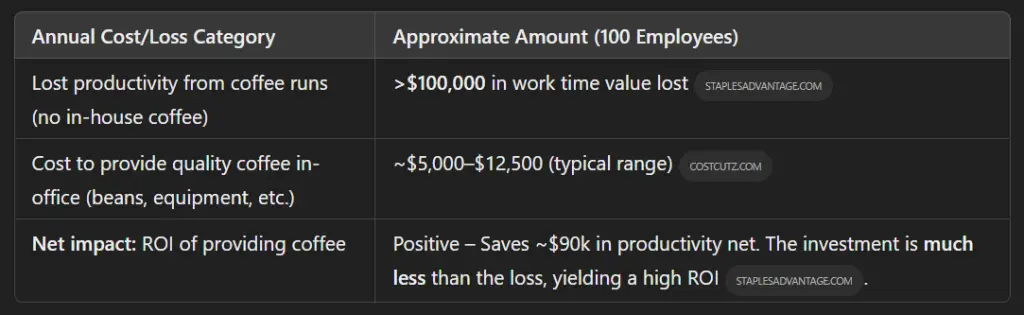
As shown above, the ROI is compelling. For relatively low cost, companies can recover tens of thousands of dollars of productive work time. From a CFO’s perspective, this is a smart trade-off – essentially turning coffee into productivity fuel.
Impact on Retention and Recruitment Costs: High turnover is extremely costly for businesses – replacing an employee can cost anywhere from 50% to 200% of their annual salary in recruiting, training, and lost experience (Surprising Employee Turnover and Retention Statistics – WebMD Health Services). While coffee alone won’t retain an employee, it is part of the broader workplace satisfaction that does influence retention. If perks like quality coffee contribute even a small increase in retention, the savings are substantial. For example, preventing the loss of one $80,000/year employee (given replacement could cost say 100% of salary) might save $80k – which could fund the coffee program for your whole office for many years. In short, by investing in employee happiness (via coffee and other perks), companies potentially save on churn costs. This indirect ROI is hard to quantify exactly, but it’s widely acknowledged that companies with content, engaged employees have lower turnover and thereby lower HR costs.
Client Impact and Business Returns: While harder to quantify than employee time, the ROI of impressing clients can be seen in client retention and revenue. A small expense on each client visit (maybe a few dollars of coffee and snacks) can contribute to winning a deal or retaining a key account, which might be worth tens or hundreds of thousands in revenue. As an illustrative example, if offering excellent hospitality (coffee included) helps secure even one contract, the revenue from that deal could dwarf years of pantry expenses. Moreover, loyal clients lead to repeat business and referrals, which are invaluable. It’s often said in customer service that small gestures have a big ROI. In this case, the return might be a strengthened client relationship that yields long-term business. While we don’t have a specific dollar figure for “ROI of a cup of coffee on client loyalty,” the logic is that client experience improvements pay for themselves. Companies routinely spend far more on client dinners and events; compared to those, coffee is a minimal cost for potentially similar goodwill.
Tangible vs Intangible Returns: It’s important to note that some ROI elements are tangible (like saved time, reduced hiring costs) and others are intangible but very real (like employee morale, brand reputation). Good coffee in the office tends to deliver on both fronts. Tangibly, fewer coffee run interruptions and more energized work hours improve output. Intangibly, employees and clients perceive the company more favorably. For the business, this means better reviews, higher engagement, and a culture that can attract talent and customers. All of these factors ultimately contribute to the bottom line, even if indirectly. In many companies, the question has moved from “Can we afford to offer nice coffee?” to “Can we afford not to?”, given the relatively high return in productivity and satisfaction for a low ongoing cost.
In conclusion, when weighing the dollars and cents, providing high-quality coffee in the office is a budget-friendly investment that yields returns in multiple areas of the business. Whether through recaptured working hours or fostering loyalty that leads to repeat sales, the consensus of studies and case examples is that a good coffee program pays off.
Conclusion
High-quality office coffee is much more than a break-room luxury – it’s a strategic asset for businesses. For employees, it fuels higher productivity, lifts morale, and reinforces a sense of being valued at work, which in turn can boost retention. For clients, it creates a welcoming, professional atmosphere that enhances their experience and can strengthen business relationships. The cost of offering great coffee is relatively low, especially when weighed against the gains: improved output, reduced downtime, happier staff, and impressed clients.
In practical terms, a premium coffee machine or catering service in the office can pay for itself by saving lost work time (no more extended cafe runs) and by contributing to a positive company culture that keeps employees engaged. Meanwhile, the same coffee helps win over visitors by demonstrating hospitality and attention to detail, possibly tipping the scales in favor of your company in a competitive marketplace. As shown by the various surveys and expert insights, businesses that invest in the “coffee experience” often see measurable improvements in employee satisfaction (with reports of morale boosts and better mood at work (The Top 6 Reasons to Provide Coffee in your Workplace | 360Connect)) and find that it’s an amenity appreciated enough to even influence where people choose to work (50% of Companies Offering “Good Coffee” to Encourage Return To Office | Comp News).
Ultimately, providing high-quality coffee is a small gesture with powerful effects. It exemplifies the idea that taking care of the little things can lead to big advantages. Companies looking to enhance productivity, foster a positive work environment, impress clients, and maximize ROI would do well to view the office coffee station not as a minor expense, but as an important tool in their overall workplace strategy. As the evidence suggests, a great cup of coffee at the right moment can benefit everyone – energizing your employees, delighting your clients, and invigorating your business results, all at the same time.
Sources:
Servomax LinkedIn – The New Role of Office Coffee in Today’s Workplace (Oct 2024) – Office coffee boosts productivity, team bonding, and job satisfaction (The New Role of Office Coffee in Today’s Workplace.) (The New Role of Office Coffee in Today’s Workplace.).
Staples Business Advantage – Workplace Coffee Survey – 80% feel more valued with high-quality beverages; 60% want better coffee options ().
Nestlé Professional – Great Coffee Boosts Productivity (2018) – On-site specialty coffee can save ~30 minutes per employee per day and improve job satisfaction (Great Coffee in the Workplace Boosts Employee Productivity) (Great Coffee in the Workplace Boosts Employee Productivity).
360Connect – Top Reasons to Provide Coffee at Work – 61% say coffee provision shows employer cares; 85% say quality coffee boosts productivity & morale; 82% in better mood with coffee, leading to higher satisfaction and less turnover (The Top 6 Reasons to Provide Coffee in your Workplace | 360Connect) (The Top 6 Reasons to Provide Coffee in your Workplace | 360Connect).
MIT Sloan Management – Study on informal interactions – Coffee breaks foster casual conversations that spark ideas and collaboration, strengthening team relationships (The New Role of Office Coffee in Today’s Workplace.) (The New Role of Office Coffee in Today’s Workplace.).
CoreNet Global Survey (2024) – 51% of companies offer “good coffee” as an amenity to encourage returning to office (post-pandemic) (50% of Companies Offering “Good Coffee” to Encourage Return To Office | Comp News).
Pot O’ Gold Coffee Service – Coffee and Productivity – Caffeine improves focus, memory, and mood, reducing stress and boosting engagement at work (The Impact of Coffee on Employee Productivity and Engagement | Pot O’ Gold Coffee Service) (The Impact of Coffee on Employee Productivity and Engagement | Pot O’ Gold Coffee Service).
Seattle Times (2023) – Case: Amazon’s plan to cut free office coffee led to 10,000 employee protest, showing how much workers value the perk.
Jacobs Douwe Egberts Prof. – Welcoming Visitors with Coffee – Offering coffee in reception signals you value visitors; acts as an ice-breaker and reinforces a positive company image (How Coffee Plays A Part In Welcoming Visitors To Your Offices) (How Coffee Plays A Part In Welcoming Visitors To Your Offices).
Nationwide Coffee (UK) – Customer Experience in Waiting Rooms – Coffee in waiting areas reduces anxiety, creates a friendly atmosphere, and leaves a lasting positive impression (clients feel valued, waits seem shorter) (How Offering Coffee Can Elevate Customer Experience in Waiting Rooms) (How Offering Coffee Can Elevate Customer Experience in Waiting Rooms).
Commonwealth Joe – Impressing Clients – Premium refreshments (coffee/tea) show attention to detail and care for client comfort, leaving a big impression on clients (5 tricks to impressing Clients from the Moment They Walk In – Commonwealth Joe Coffee Roasters) (5 tricks to impressing Clients from the Moment They Walk In – Commonwealth Joe Coffee Roasters).
USA Wire – Investing in a Commercial Coffee Machine – High-quality coffee service differentiates your brand and builds customer loyalty; contributes to a better customer experience and repeat business (Commercial Coffee Machine Investment: 8 Worthwhile Reasons) (Commercial Coffee Machine Investment: 8 Worthwhile Reasons).
Globenewswire (Packaged Facts Report, 2024) – Average daily coffee run = 60 hours lost per employee/year; >$1,100 productivity cost each (US Office Coffee Services Market Trends & Opportunity). Emphasizes providing coffee as cost-effective compared to time lost.
CostCutz – Office Coffee Service Cost – Typical cost ~$50–$125 per employee/year for coffee service (low cost for potentially high returns) (How Much Does Office Coffee Service Cost?).
WebMD Health Services – Employee Retention Stats (2025) – Replacing an employee can cost 50–200% of salary (Surprising Employee Turnover and Retention Statistics – WebMD Health Services), highlighting value of retention efforts (like perks) to avoid turnover costs.