
Introduction
Premium Italian bean-to-cup coffee machines offer an all-in-one solution for brewing high-quality espresso-based beverages at the touch of a button. These fully automatic machines grind fresh beans and prepare coffee specialties consistently, combining Italian craftsmanship with modern convenience. In this report, we explore a wide range of applications for such machines across various business settings in Canada.
Both customer-facing scenarios (enhancing the customer or guest experience) and internal use cases (employee-focused amenities) are considered.
We examine industries from hospitality and food service to retail, offices, co-working spaces, automotive showrooms, and high-end boutiques. Along the way, we highlight how the coveted “Made in Italy” label and premium positioning of these machines can boost brand image, enrich customer experience, and add perceived value.
We also discuss practical benefits including automation, consistency, cost savings versus hiring baristas, and ease of maintenance.
The “Made in Italy” Premium Advantage
“Made in Italy” is essentially a brand unto itself, synonymous with luxury, quality, and craftsmanship. Italian-made products enjoy a global reputation for excellence, from fashion to sports cars, and coffee equipment is no exception benarioconsulting.com.
A premium Italian coffee machine signals to customers that the business values authenticity and top-tier quality. The Italian origin can enhance the perceived value of the coffee service – customers often associate Italy with espresso heritage and expect a superior cup. For businesses, showcasing an Italian-designed machine (with its elegant styling and renowned engineering) can elevate the ambiance and align with a luxury brand image.
In high-end settings, the Italian branding becomes a talking point and a mark of exclusivity, reinforcing to clients that they are being offered the very best. This cachet adds intangible value beyond the coffee itself, contributing to a memorable experience and positive impressions of the business.
Practical Benefits: Automation, Consistency, and Efficiency
Beyond branding, premium bean-to-cup machines deliver tangible operational advantages. They automate the entire coffee-making process – from grinding beans to frothing milk – ensuring consistency in every cup. Each brew is made to the same high standard, which keeps quality reliable and customer expectations met
.
This consistency is difficult to achieve manually and means even staff with minimal training can serve excellent coffee. Automation also drives speed and efficiency. These machines can produce beverages in seconds, reducing wait times and increasing service speed during busy periods
.
For example, during a morning rush or conference break, an automatic machine can serve cup after cup rapidly, improving throughput without sacrificing quality.
Another benefit is cost savings compared to maintaining a staffed espresso bar. Bean-to-cup machines grind only the needed amount per cup, minimizing waste and saving on coffee costs over time unitedfastfood.com.
By handling brewing with one-button operation, they reduce labor requirements, freeing employees to focus on other tasks unitedfastfood.com.
Businesses can offer barista-style drinks without the expense of dedicated barista staff or extensive training. Over the long run, this can be more economical than buying coffee externally or operating a full café. Additionally, many premium machines are designed for easy maintenance and cleaning. Features like automatic rinsing cycles and modular parts keep upkeep simple, meaning less downtime and technical intervention. Modern commercial models are built to be user-friendly and low-maintenance, as noted in the automotive sector where machines are “easy to clean” and “low maintenance,” saving money in the long run liquidline.co.uk.
This reliability is crucial for busy workplaces that need a dependable coffee supply with minimal hassle.
Finally, providing great coffee on-site can boost morale and productivity in internal use cases. Employees appreciate having gourmet coffee readily available at work; it spares them trips offsite and shows that the company cares about their comfort. In fact, offering an array of quality coffee drinks at the push of a button can save staff time (no more waiting on kettle boils or coffee runs) and create a cleaner, more efficient break room liquidline.co.uk.
Better coffee can act as a welcomed perk that keeps people energized and satisfied – a mental stimulant that can improve morale and alertness on the job liquidline.co.uk.
Hospitality Industry (Hotels & Resorts)
In hospitality settings like hotels, resorts, and bed-and-breakfasts, a premium Italian bean-to-cup machine can significantly elevate the guest experience. Customer-Facing Use: Hotels can place these machines in lobbies, lounges, or breakfast areas for self-service gourmet coffee at any hour. Guests enjoy the convenience of getting a barista-quality cappuccino or espresso on demand, without leaving the premises. This round-the-clock availability of fresh coffee is a simple amenity that can increase guest satisfaction and comfort during their stay cafedumonde.co.uk.
Guests often remember the small luxuries; being able to sip a rich Italian espresso in the lobby or their room can make their stay feel more upscale and home-like. It also gives a hotel a competitive advantage – travelers may choose one property over another because it offers superior coffee as a free perk cafedumonde.co.uk.
In boutique or luxury hotels, an elegant Italian machine in the breakfast room or executive lounge reinforces the hotel’s premium image, letting guests know that every detail, down to the coffee, is high-quality and authentic.
Internal Use: While the main focus in hospitality is on guests, staff can also benefit. Hotel employees working long shifts appreciate convenient access to good coffee to keep them alert and hospitable. For instance, catering staff can quickly prepare consistent espresso-based drinks for banquets or meetings with minimal training, thanks to the machine’s automation. This saves time and ensures every guest receives a great cup, even in high-volume conference settings.
Moreover, ease of operation means any staff member can produce specialty coffees at a touch, reducing the need for a skilled barista on staff. As one industry guide notes, self-service bean-to-cup units in hotel breakfast areas are easy for guests to use and don’t require staff assistance, saving on labor costs cafedumonde.co.uk.
Overall, in the hospitality sector, an Italian bean-to-cup machine can enhance both guest-facing service (through convenience and luxury ambiance) and back-of-house efficiency.
Food Service (Restaurants & Cafés)
Restaurants, cafés, and catering businesses can leverage premium bean-to-cup machines to improve consistency and broaden their drink offerings.
Customer-Facing Use: In full-service restaurants, these machines are perfect for providing after-meal espresso, cappuccinos, or lattes of a quality that matches the cuisine. Instead of training waitstaff as baristas or hiring additional personnel, restaurants can rely on the machine to deliver authentic Italian-style coffee at the press of a button. This ensures that every diner’s after-dinner cappuccino tastes excellent and is served quickly, enhancing the overall dining experience.
Automation helps maintain speedy service; even during a busy dinner rush, the staff can produce desserts and coffees in parallel. The high throughput capability means more guests can be served their coffee faster, with bean-to-cup systems reducing wait times and improving service speed during peak hourskaapimachines.com.
Quick-service food outlets and cafés also benefit – they can offer a full espresso menu (from Americanos to macchiatos) without the complexity of manual machines. A fast-casual eatery, for example, might use a bean-to-cup unit to add premium coffees for customers on-the-go, driving additional revenue with minimal effort.
There are clear cost and consistency advantages for food service operators. The machine will dose and brew precisely, resulting in less wasted coffee and ingredients (saving costs). Each cup comes out with the same recipe and quality, which is crucial for building a reputation for great coffee across multiple locations or shifts. By grinding beans fresh for each cup, these machines guarantee flavor consistency that can keep customers happy every time unitedfastfood.com – a critical factor for repeat business in cafés.
They also cut down on training time; any staff member can produce high-end drinks, which is valuable in high-turnover environments. In terms of maintenance, commercial models often have self-cleaning cycles and alert staff when attention is needed, simplifying upkeep in a busy kitchen.
The Italian premium branding can be a marketing angle as well: a trattoria or Italian restaurant in Canada might proudly mention that their espresso is made with an Italian machine, reinforcing authenticity. Even in non-Italian eateries, having a visibly high-end European coffee machine on the counter adds to the venue’s prestige and signals to patrons that the restaurant invests in quality across the board.
Offices and Corporate Workplaces
Providing great coffee in offices has become an expectation, and a premium bean-to-cup machine can dramatically improve the workplace coffee culture. Internal/Employee Use: In corporate offices and other workplaces, these machines serve employees and visiting clients or partners.
For employees, a bean-to-cup machine offers a wide variety of cafe-style drinks – espresso, cappuccino, latte, or just a perfect cup of fresh-brewed coffee – all readily available throughout the day. This convenience can boost employee satisfaction and morale, as having good coffee on hand is perceived as a valuable perk. Studies and anecdotes alike suggest that coffee keeps employees alert and can enhance focus and productivity linkedin.com, liquidline.co.uk.
Instead of spending time and money on coffee runs to the café down the street, employees can get their caffeine fix on-site, which can improve time management. One report notes that having diverse, unlimited coffee choices at the touch of a button saves staff time and effort, eliminating the need to boil kettles or go out for mid-day lattes liquidline.co.uk.
It also tidies up the office environment – no more loose pods or messy drip machines – resulting in a cleaner break room and fewer spills.
For the company, offering premium coffee reflects a commitment to employee well-being. It can be a relatively low-cost benefit that yields higher morale and fosters informal interaction (employees from different departments might bump into each other at the coffee station, sparking conversations).
Customer-Facing Use: In client-facing areas like meeting rooms or reception, an Italian bean-to-cup machine allows a business to serve guests impressive refreshments with ease. A freshly made cappuccino for a visiting client can create a welcoming atmosphere and positive impression. This is especially valuable in industries where hospitality towards clients is part of the culture (e.g. consulting firms, banks, real estate offices).
The premium Italian branding of the machine also subtly communicates quality – a sleek Italian appliance in the lobby suggests that the company pays attention to detail and invests in the best tools. In summary, offices benefit from both the practical advantages (time and cost savings, productivity gains) and the image boost (prestige and hospitality) that come with a top-of-the-line coffee machine.
Co-working Spaces and Shared Offices
Co-working spaces and shared office hubs thrive on amenities, and coffee is often considered the lifeblood of these communities. Customer-Facing Use (Members): A premium coffee machine is frequently a centerpiece amenity in co-working lounges, providing freelancers, entrepreneurs, and remote workers with gourmet coffee on demand. Many co-working operators find that investing in a high-end coffee setup “pays dividends in member satisfaction and retention” optixapp.com.
Members appreciate unlimited access to quality lattes or flat whites as part of their monthly fee – it adds tangible value to their workspace rental. This can be a deciding factor for someone choosing a co-working space; a professional, barista-grade coffee machine (especially one with Italian pedigree) can differentiate one space from another. For instance, a co-working hub in Vancouver equipped all its locations with premium machines offering a full espresso menu, and it became a strong differentiator that resonated with the community optixapp.com.
Beyond the beverages themselves, the coffee area often becomes a social hub. Spontaneous chats over a cup can lead to networking and collaboration. As one workspace provider noted, a simple “casual chat over coffee” can spark new partnerships or even lucrative deals among members sentientworkspace.com.
In this way, the coffee machine indirectly facilitates community building and business opportunities within the co-working environment.
Internal Use: The co-working staff also benefit from an easy-to-use machine to serve any guest tours or events without needing specialized barista skills. Operationally, the machine’s automation and consistency help manage peak times (like Monday mornings or meetup events held in the space) without additional staff. It’s also often more cost-effective than providing free coffee via outside vendors or stocking many individual brewing devices.
The Made in Italy premium factor contributes here by elevating the space’s ambiance – many co-working spaces have hip, beautifully designed kitchens, and an Italian espresso machine fits that aesthetic. It signals a certain standard of quality and can even be featured in marketing materials (e.g., “enjoy authentic Italian espresso at our workspace café”).
Overall, in co-working settings, a bean-to-cup coffee machine is both a practical amenity and a marketing asset, driving member happiness and creating a buzz that sets the space apart.
Retail Environments (Stores & Showrooms)
In retail, especially brick-and-mortar stores in an era of online shopping, providing an exceptional in-store experience is key to drawing customers in. Offering premium coffee to shoppers is an increasingly popular strategy to enhance customer experience and encourage shoppers to linger.
Customer-Facing Use: A high-end bean-to-cup coffee machine can be set up in retail showrooms (from furniture galleries to large apparel stores) to serve complimentary espresso, cappuccino, or other drinks to visitors. This kind of hospitality can keep customers in the shop longer and build brand loyalty scanomat.com.
When shoppers are invited to relax with a cup of freshly brewed Italian coffee, they are more likely to slow down, browse more products, and have a positive impression of the store’s service. Not only does it create a warm, welcoming atmosphere, but it can also translate into sales. Notably, research has shown that consumers who have a caffeinated beverage before or during shopping tend to spend more and purchase a greater number of items impulsively retailcustomerexperience.com.
In one experiment, shoppers who drank an espresso before browsing a store spent about twice as much money as those who had a decaf drink retailcustomerexperience.com. This suggests that providing coffee on-site could indirectly boost retail sales by increasing customer alertness and impulsivity in a pleasant way.
Even aside from the biochemical effect, the gesture of hospitality puts customers in a good mood, making them more receptive to the products. For example, a high-end furniture showroom might greet clients with an Italian espresso as they discuss customizations, making the shopping experience feel more luxurious and personal.
Made in Italy branding can play a role here too – a store that aligns itself with quality might choose an Italian machine to reinforce its identity. If the store sells Italian decor or fashion, the coffee offering becomes part of a cohesive theme of Italian elegance. Some retailers even integrate coffee bars within the store as an added service.
While not every shop will open a full café, simply having a premium machine in a corner with a standing bar can set the store apart from competitors. This approach is part of a broader trend in experiential retail: retailers are finding that giving customers additional reasons to visit (like a great cup of coffee or a comfortable lounge area) enhances satisfaction and loyalty in an age where experience is king scanomat.com.
Internal Use: In retail settings, employees can also take advantage of the machine on breaks, which keeps staff energized and happy (and avoids them leaving the store for coffee runs). However, the primary benefit in retail is customer-facing. The ease of maintenance and reliability of these machines is important since they might run all day in a store – premium models are up to the task, needing only minimal daily attention.
In summary, a premium bean-to-cup coffee machine in a retail environment acts as a differentiator that can enhance the shopping experience, reflect the store’s quality values, and even contribute to better sales outcomes through longer dwell times and boosted customer goodwill.
Automotive Showrooms
Automotive showrooms, especially those selling luxury or premium vehicles, have embraced quality coffee as part of their customer service ethos.
Customer-Facing Use: When potential car buyers walk into a dealership, being offered a barista-quality coffee can immediately elevate their perception of the service. A premium Italian coffee machine in the showroom lounge allows sales staff to offer visitors lattes or espressos while they browse or negotiate – creating a relaxed, welcoming environment. This hospitality encourages customers to linger longer, which in turn can lead to increased sales opportunities liquidline.co.uk.
Shoppers who might otherwise leave after a quick look may stay for an extra cup and conversation, giving sales representatives more time to engage with them. As one industry source points out, a premium beverage adds to the customer experience and can give buyers more time to contemplate a major purchase while “sipping away at their caffeinated beverage.” liquidline.co.uk.
In practice, something as simple as complimentary espresso can differentiate a dealership: it signals that the dealership goes the extra mile to make guests comfortable. This positive experience can improve customer service perception and become memorable (people might tell friends “that dealership has amazing cappuccino!”). Over time, it can even help build customer loyalty, with clients returning not just for cars but also the pleasant environment liquidline.co.uk.
For luxury car brands, aligning the showroom with premium Italian coffee also aligns with the notions of craftsmanship and luxury lifestyle – imagine shopping for an Italian sports car while enjoying an authentic Italian espresso, the experiences reinforce each other.
Internal Use: Dealership employees benefit as well. Salespeople and service staff often work long hours; having quality coffee on hand keeps them alert and motivated. A bean-to-cup machine provides quick caffeine fixes without staff leaving the premises (no need to run out to a café between appointments). This convenience can improve staff productivity as time isn’t wasted brewing coffee manually or going off-site liquidline.co.uk.
It also contributes to a more upbeat workplace culture – employees feel taken care of and can recharge with a good coffee, which can boost morale and energy levels on the sales floor liquidline.co.uk. Happier, more alert staff are likely to perform better and impart that positivity to customers. On the practical side, showroom managers appreciate that these machines are easy to operate and maintain, requiring little attention so the team can focus on sales.
Overall, in automotive showrooms a premium coffee machine serves as both a customer amenity that enhances the dealership’s brand image and a staff amenity that streamlines operations and uplifts the team.
High-End Boutiques and Luxury Retail
In high-end boutiques – such as luxury fashion houses, jewelry stores, designer furniture galleries, and upscale boutiques – every detail of the customer experience is carefully curated to reflect the brand’s exclusivity and quality. Offering artisan coffee prepared by a premium Italian machine can be a subtle but powerful touch in these environments.
Customer-Facing Use: A boutique might offer clients a complimentary espresso or macchiato while they browse couture or try on watches. This kind of white-glove service creates a relaxed atmosphere where customers feel pampered. The presence of a gleaming Italian espresso machine in a boutique’s VIP lounge or corner of the showroom underscores the store’s commitment to excellence and craftsmanship. It aligns with the values of luxury brands, as the in-store coffee experience resonates with the sense of exclusivity and fine craftsmanship that high-end customers expect.
In fact, luxury brands across the world have been integrating cafés and coffee bars into their stores as a way to immerse customers in the brand lifestyle and offer more than just products – they offer an experience. The idea is that enjoying a beautifully made cappuccino from an Italian machine becomes part of the storytelling of the brand (for example, an Italian fashion label might serve Italian coffee to emphasize its heritage).
This added hospitality can set a boutique apart from others; while two stores might sell similar high-end products, the one that hands you a rich crema-topped espresso as you walk in may well leave a stronger impression.
Importantly, the coffee offering isn’t just about taste – it’s about the brand image and perceived value. Customers in luxury boutiques are often spending significant amounts; giving them a premium coffee or latte for free can enhance their perception of getting a fully luxurious treatment. It reinforces that they are valued guests, not just transactions.
Such thoughtful amenities can increase the likelihood of purchase by putting customers at ease and allowing more time to appreciate the products. It can also generate goodwill and word-of-mouth (“They even offered me Italian espresso while I shopped!”). Made in Italy branding plays perfectly here: many luxury boutiques carry Italian or European designer goods, so an Italian coffee service feels congruent. The cachet of Italy’s coffee reputation adds authenticity – it’s not just any coffee, it’s Italian coffee, which psychologically bolsters the boutique’s luxury credentials.
Internal Use: In a smaller boutique, the staff themselves (who are often brand ambassadors) will use the machine to serve customers and occasionally for their own breaks. The ease-of-use is key, since sales associates can make a quick coffee for a client without leaving the floor or breaking the flow of conversation.
Maintenance needs to be minimal because boutique staff have to prioritize customer service. Premium machines in this category are typically streamlined and require just occasional refilling and cleaning, which can be done during slow periods.
In essence, for high-end boutiques, a bean-to-cup coffee machine is less about volume and more about enhancing the exclusivity and hospitality. It serves as a differentiator that elevates the boutique shopping experience to something more akin to visiting a private club or a friend’s elegant home – a place where you are welcomed and indulged, not just sold to.
Summary of Applications by Business Type
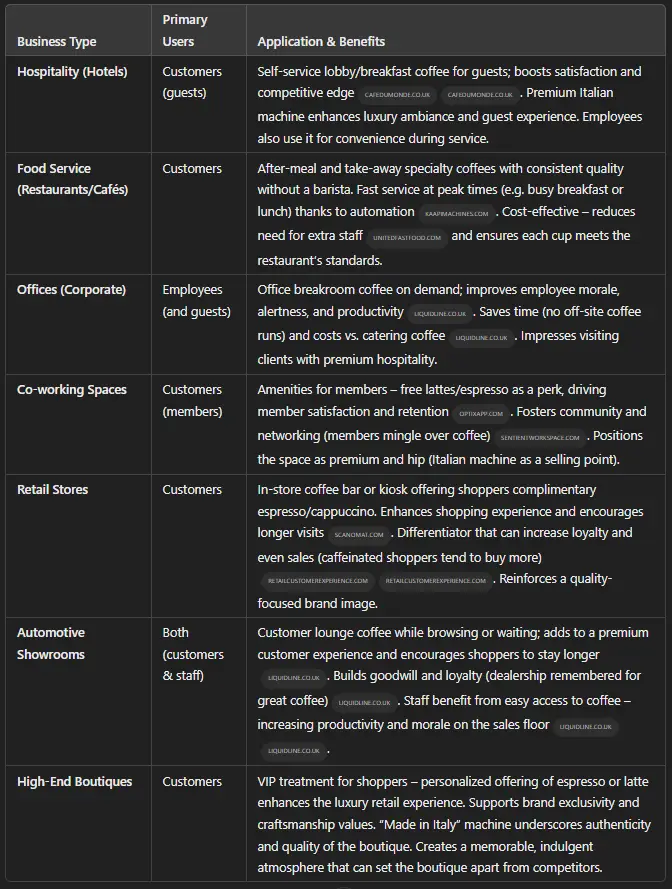
The table below summarizes key applications of premium Italian bean-to-cup coffee machines across various business types, indicating whether the primary users are customers, employees, or both, and highlighting the core purpose or benefit in each setting.
Conclusion
Across industries, a premium Italian bean-to-cup coffee machine serves as a versatile asset – delighting customers, rewarding employees, and streamlining operations.
In hospitality and food service, it ensures guests receive excellent coffee with minimal wait and labor, reinforcing an establishment’s quality standards.
In offices and co-working hubs, it boosts daily satisfaction and productivity, symbolizing an investment in people.
In retail, automotive, and luxury boutique settings, it becomes part of the experiential offering, adding a touch of hospitality and distinction that can drive both loyalty and sales.
The Made in Italy label further amplifies these benefits by lending an aura of authenticity, luxury, and trusted craftsmanship to the coffee service.
Ultimately, whether it’s a hotel guest starting their day with a perfect cappuccino or a boutique customer sipping espresso while selecting a handbag, the presence of a high-end Italian coffee machine can be a real differentiator.
It not only consistently delivers delicious coffee, but also communicates a message: that quality, convenience, and customer care are high priorities for the business. This union of practical benefit and brand positioning is what makes such coffee machines valuable in so many Canadian business settings today.